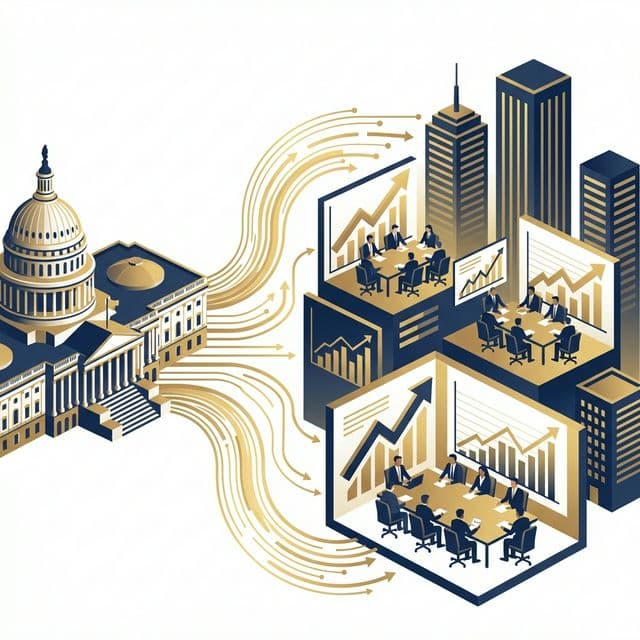
Companies that spend heavily on lobbying often see favorable legislation and regulatory outcomes. Here's how to use lobbying data as a leading indicator for stock performance.
Lobbying: The Leading Indicator Wall Street Ignores
Every quarter, companies, trade associations, and interest groups file detailed lobbying disclosure reports with Congress. These reports reveal exactly how much money is being spent to influence specific pieces of legislation, regulatory decisions, and government policy. For investors, this data is a goldmine — and it is almost entirely overlooked by mainstream financial analysis. This is one of the six key data sources in our complete guide to congressional stock trading.
The Scale of Lobbying
U.S. lobbying expenditure consistently exceeds $4 billion per year. The top sectors by spending include:
- Pharmaceuticals & Health: ~$370M/year — drug pricing, FDA regulations, Medicare reimbursement
- Technology: ~$250M/year — antitrust, AI regulation, data privacy, Section 230
- Insurance: ~$180M/year — healthcare reform, rate regulation
- Oil & Gas / Energy: ~$150M/year — environmental regulation, subsidies, pipeline approvals
- Defense: ~$130M/year — appropriations, foreign military sales, contract awards
Companies do not spend this money for fun. Lobbying is an investment — and it has one of the highest ROIs of any corporate expenditure.
The Research: Lobbying ROI
Academic research has consistently shown that lobbying generates outsized returns:
- A landmark study from the University of Kansas found that firms engaging in tax lobbying received a return of $220 for every $1 spent on lobbying — a 22,000% ROI.
- Companies that lobby heavily for government contracts, subsidies, or favorable regulation consistently outperform their non-lobbying peers.
- Spikes in lobbying expenditure often precede favorable legislative or regulatory outcomes by 6–18 months — making it a leading indicator.
How to Read the Lobbying Signal
1. Sudden Increases in Spending
When a company that has historically spent $500K/year on lobbying suddenly ramps to $3M/year, something is happening. Either they are trying to push favorable legislation through, or they are trying to block unfavorable regulation. Either way, the issue is material enough to their business that they are investing significant resources.
2. Targeted Issue Lobbying
Lobbying reports disclose the specific issues being lobbied. When a pharmaceutical company lobbies on "Medicare Part D reimbursement rates" and a member of the Finance Committee simultaneously buys that company's stock, the convergence of signals is powerful.
3. Coalition Lobbying
When multiple companies in the same industry all increase lobbying spending on the same issue at the same time, it suggests an industry-wide catalyst is approaching. This could be a new regulation, a subsidy program, or a government contract cycle.
The Congressional Trading Connection
Lobbying data becomes even more powerful when cross-referenced with congressional trading data. The pattern to watch:
- Company X increases lobbying spending on Issue Y
- Members of the committee with jurisdiction over Issue Y start buying Company X stock
- Favorable legislation or regulation passes 6-12 months later
- Company X stock appreciates
This is the "lobbying-to-legislation pipeline" — and it is traceable in the data. TraderCongress tracks all three signals (lobbying reports, congressional trades, and government contract awards) in a single dashboard.
Practical Applications
- Screen for lobbying spikes: Companies with sudden increases in lobbying spend are often positioning for a material catalyst.
- Match lobbying issues with committee trades: If the lobbied issue aligns with the committee jurisdiction, and committee members are trading the stock, the signal is strong.
- Track the lobbying → legislation → contract pipeline: Lobbying leads to legislation, legislation leads to contracts, contracts lead to revenue. Follow the full chain.
- Use lobbying as a macro signal: Industry-wide lobbying trends often predict which sectors will benefit from upcoming policy shifts — see how specific bills move stocks.
Lobbying data is the most underutilized alternative data source available to retail investors. When combined with congressional trades, SEC insider filings, and government contract awards, it provides a comprehensive view of how political money flows through Washington — and into the market.