Six months ago, you had four options if you wanted to invest in quantum computing pure plays. Today? Seven. And three more are sitting in the IPO pipeline waiting to go public.
Six months ago, you had four options if you wanted to invest in quantum computing pure plays. Today? Seven. And three more are sitting in the IPO pipeline waiting to go public.
That kind of expansion doesn't happen by accident. The sector is maturing. The money is flowing. And for the first time ever, every single quantum computing architecture has a publicly tradable stock behind it.
But here's the thing nobody wants to admit. Most people buying quantum stocks right now are doing it based on a headline they half-read or a chart they glanced at for five seconds. They don't have a framework. They don't have a baseline. They're just guessing.
That ends today.
At TraderCongress, we've been tracking quantum stocks since the space had exactly two names you could trade. What follows is the most complete breakdown of the best quantum stocks available right now—not just ticker symbols and price targets, but the actual architecture behind each company, the revenue (or lack of it), and a framework for deciding whether any of these belong in your portfolio.
Let's get into it.
The 37% Rule: Why You Need to Watch Before You Commit
There's a concept from mathematics called the 37% rule. The idea is simple but powerful. Before you commit to any big decision, spend roughly the first 37% of your decision window just watching. Observe. Learn what good looks like. Build your baseline.
Then, when something comes along that beats everything you've seen so far? That's when you move.
Keep this in the back of your mind as we walk through these companies. Because by the time you finish reading this post, you'll have done the watching. You'll know the four architectures. You'll know which companies have real revenue and which ones are pure technology bets. You'll know who's established, who's brand new, and who's coming down the pipeline.
That baseline is your edge. Most quantum investors don't have one.
Four Ways to Build a Quantum Computer (And Why It Matters)
Here's something most quantum stock coverage completely ignores. There are four fundamentally different ways to build a quantum computer. Not variations on a theme. Four completely separate engineering approaches.
And for the first time in history, all four are publicly investable.
This matters more than you might think. You're no longer forced to bet on one approach and hope it's the winner. You can spread exposure across multiple architectures. You can hedge your bets intelligently.
Here are the four approaches and the companies behind them:
| Architecture | How It Works | Public Pure Plays |
|---|---|---|
| Superconducting | Circuits cooled near absolute zero | D-Wave (annealing), Rigetti (gate-model) |
| Trapped Ion | Atoms held by electromagnetic fields | IonQ, Quantinuum (upcoming IPO) |
| Neutral Atom | Laser-trapped neutral atoms | Inflection, IQM (upcoming IPO) |
| Photonic | Light particles at room temperature | Xanadu, Pascal (upcoming IPO) |
Let's break down each company. The good, the risky, and the ones you should probably avoid.
D-Wave Quantum (QBTS): The One Solving Real Problems Today
D-Wave uses a superconducting approach called annealing. And annealing isn't some theoretical future capability. It solves optimization problems that exist right now.
Think supply chain routing. Drug discovery scheduling. Financial risk modeling. Companies are paying for this today—not in 2030, not "when the technology matures." Today.
The Numbers
- Full-year 2025 revenue: Up 179% year-over-year
- January-February 2026 bookings: Already exceeded all of 2025 annual revenue
Read that second bullet again. In just the first two months of 2026, D-Wave booked more in new contracts than they did during the entire previous year. That's not gradual growth. That's demand acceleration.
The Hidden Story
Here's what most coverage has completely missed. In January 2026, D-Wave completed an acquisition that gives them a second quantum architecture. They now have gate-model capability sitting alongside their annealing system.
Current status: 8 qubits operational. Roadmap calls for 17 qubits by mid-2026 and 49 by 2027. That's a working system on a 12-month build schedule.
D-Wave is no longer a one-trick pony. They're hedging their architecture bet, and that makes them one of the more compelling names among the best quantum stocks right now.
IonQ (IONQ): The Largest Pure Play with a Manufacturing Play
IonQ uses the trapped ion approach. Instead of superconducting circuits, they hold individual atoms in place using electromagnetic fields. Trapped ion systems are known for being the most precise of all quantum architectures.
IonQ is the largest quantum pure play by both revenue and market cap. And the growth numbers are staggering.
The Numbers
- Backlog (Oct 2025): $77 million
- Backlog (today): Nearly 5x that amount
- Revenue growth: Tripled year-over-year, up 202%
The SkyWater Acquisition
Here's the bombshell. IonQ announced a $1.8 billion acquisition of SkyWater Technology, a trusted U.S. semiconductor foundry.
If this deal closes, IonQ would own the entire quantum computing manufacturing process from start to finish. All on U.S. soil.
Why does that matter? Two words: Pentagon contracts.
IonQ is now cleared to compete for U.S. defense quantum work. Owning a domestic manufacturing pipeline isn't just a cost play—it's a strategic moat that foreign competitors can't easily replicate. When the Department of Defense starts writing checks for quantum systems, IonQ will be one of the few companies positioned to cash them. You can read more about how government contracts move stock prices.
This vertical integration thesis is why many analysts consider IonQ among the best quantum stocks for long-term exposure.
Rigetti Computing (RGTI): High Concentration Risk
Rigetti uses superconducting gate-model technology. The science is legitimate. But the financials tell a story worth understanding.
The Concentration Problem
Two contracts represent 63% of Rigetti's 2026 revenue estimate:
- An order from India's C-DAC research organization for a 108-qubit system
- A Novara QPU hardware delivery
Both delivery timelines have already slipped from the first half to the second half of 2026.
Here's the honest truth. Quantum hardware orders slip. That's part of the territory with early-stage hardware companies. If you own Rigetti or are considering buying, you're making a concentrated bet on their superconducting roadmap and their ability to close the gap with IBM and Google.
That could pay off handsomely. Or those delays could compound. Know what you're signing up for.
Quantum Computing Inc. (QUBT): Proceed with Extreme Caution
Let's be straightforward about this one.
QUBT's 2025 revenue was $682,000. Not $682 million. Not $6.82 million. Six hundred eighty-two thousand dollars.
Their 10-K filing carries a going-concern warning. The company is facing securities fraud lawsuits. Short sellers have alleged that QUBT overstated its relationship with NASA and that some of the reported revenue was never real.
Those are very serious allegations.
Between the going-concern warning, the litigation, and the microscopic revenue number, QUBT is absolutely the highest-risk name on this list. If you decide to touch it, do so with full awareness that you could lose your entire investment. This is not a stock for anyone looking for the best quantum stocks with reasonable risk profiles. This is a lottery ticket.
Keep your head on a swivel if you follow this one.
The New Entrants: Two Fresh Architectures Hit Public Markets
The established names above cover two of the four architectures—superconducting and trapped ion. Now let's look at the three quantum pure plays that went public in the last two months. They bring the other two architectures to the public market for the first time.
Pay attention here. These names are new, and most investors haven't heard of them yet.
Inflection (IFLD): The Neutral Atom Play
Inflection went public in February 2026. They use the neutral atom architecture, which has a significant scaling advantage. Neutral atom systems can reach thousands of qubits without the engineering nightmares that other approaches run into.
The Nvidia Connection
Here's what separates Inflection from the pack. Nvidia selected Inflection for two separate quantum programs. That's not a vague "partnership" with a press release and no substance. Nvidia chose this company twice—out of every quantum company on the planet.
In a sector where credibility signals matter enormously, that's about as strong as they come.
Dual Revenue Streams
Inflection has something most quantum companies don't: two revenue streams.
- Quantum computing (long-term upside)
- Quantum sensing (real deployed hardware today)
Their sensing systems are already operational—including hardware running on the International Space Station for NASA.
Revenue topped $32 million last year with 23% growth guided for 2026. For a quantum company that's been public for only a couple of months, that's real commercial traction.
Inflection is still early stage, but the combination of Nvidia backing and dual revenue streams this quickly out of the gate makes it one to watch closely.
Xanadu (XANAU): The Photonic Play with a Software Moat
Xanadu went public in March 2026 and brings the fourth and final architecture: photonic quantum computing.
Their Aurora system operates at room temperature because photons don't require the extreme cooling that superconducting qubits demand. That's a genuine engineering advantage for scaling—no dilution refrigerators, no cryogenic infrastructure.
But here's what really makes Xanadu interesting.
The PennyLane Software Platform
Xanadu built an open-source quantum programming framework called PennyLane. And it's not just another developer tool. It's becoming the industry standard.
- Used by half of all quantum developers worldwide
- 160,000 monthly downloads
- Usage grew 161% last year alone
Here's the critical insight. PennyLane works across all hardware architectures. It doesn't matter whether superconducting, trapped ion, neutral atom, or photonic wins. PennyLane serves them all.
With Xanadu, you're getting two investment cases in one stock:
- The photonic hardware bet (speculative, but room temperature is a real edge)
- The software platform that's becoming the industry standard (less architecture-dependent risk)
The stock has been volatile since launch. Revenue is still early. This is speculative. But that software layer provides a degree of downside protection that most quantum pure plays simply don't offer.
Horizon Quantum (HQGE): The Architecture-Agnostic Middleware
Horizon Quantum closed its SPAC in March 2026 and now trades on Nasdaq. They build hardware-agnostic quantum software tools.
Think of them as the middleware layer. They win regardless of which architecture ultimately takes off. If you believe multiple quantum architectures will coexist—or if you're simply unsure which one will dominate—Horizon gives you exposure without forcing a hardware bet.
The Microcap Quantum Security Plays
Beyond computing, there are two microcap names worth knowing in quantum security:
- CLSQ: Builds post-quantum encryption chips designed to protect systems before quantum computers can crack today's encryption standards
- Arqit: Works on quantum-safe key distribution
Both are pre-revenue and extremely early. But they round out the investable quantum universe—because quantum computing creates security risks that need solving too.
The IPO Pipeline: Three More Names Coming
The pure play universe isn't done expanding. Three major IPOs are in the works:
Quantinuum
Majority-owned by Honeywell. Filed S-1 confidentially in January 2026. Targeting an IPO valuation of around $20 billion—which would make it the largest quantum company to go public by far. Quantinuum is a trapped-ion leader with real revenue and a deep patent portfolio.
IQM (Finland)
Going public via SPAC at a $1.8 billion valuation. Expected to close in June 2026. IQM focuses on superconducting quantum computers and has strong European government backing.
Pascal (France)
Targeting a $2 billion SPAC listing in the second half of 2026. Photonic quantum focus, similar to Xanadu but with a different technical approach.
By the end of 2026, there could be eight or more publicly traded quantum pure plays spread across all four architectures. That has never happened before in this sector.
The Infrastructure Layer: The Quiet Winners
Before we get to allocation strategy, there's a layer most quantum stock guides completely skip.
The infrastructure companies.
- Amazon Web Services hosts five quantum hardware providers on a single cloud platform
- Microsoft Azure Quantum hosts four of them
- Nvidia's software platform integrates with 75% of the world's quantum processors, and their venture arm backed Quantinuum, Q-Era, and PsiQuantum in rounds totaling over $1.8 billion
These companies already have enormous, profitable businesses. They don't need quantum to succeed. But when quantum does succeed, they become the toll collectors—earning revenue no matter which architecture wins.
If you've read TraderCongress before, you know we've covered these infrastructure names extensively. They're stronger now than they were six months ago. And they still deserve the largest slice of any quantum allocation because they win regardless of which hardware architecture comes out on top.
Politician Trading Activity: What Washington Is Buying
Here's something worth paying attention to. Recent congressional trading disclosures show notable activity in quantum-adjacent stocks:
| Politician | Chamber / Party | Ticker | Company | Transaction | Date |
|---|---|---|---|---|---|
| W. Gregory Steube | House / R | IONQ | IonQ Inc. | Purchase | Mar 18, 2026 |
| Maria Elvira Salazar | House / R | HON | Honeywell International | Purchase | Mar 24, 2026 |
| Sheri Biggs | House / R | IBIT | iShares Bitcoin Trust | Purchase | Mar 4, 2026 |
| Byron Donalds | House / R | BTC | Grayscale Bitcoin Mini Trust | Purchase | Dec 18, 2025 |
| Cleo Fields | House / D | GOOGL | Alphabet Inc. | Purchase | Jan 20, 2026 |
| John Boozman | Senate / R | MSFT | Microsoft Corp. | Purchase | Mar 5, 2026 |
| Cleo Fields | House / D | TSM | Taiwan Semiconductor | Purchase | Apr 9, 2026 |
| Maria Elvira Salazar | House / R | CSCO | Cisco Systems | Purchase | Mar 19, 2026 |
| Maria Elvira Salazar | House / R | GLW | Corning Incorporated | Purchase | Mar 19, 2026 |
| Maria Elvira Salazar | House / R | GS | Goldman Sachs Group | Purchase | Mar 19, 2026 |
| Dwight Evans | House / D | MU | Micron Technology | Sale | Mar 24, 2026 |
The purchases in IonQ (IONQ) and Honeywell (HON)—the parent company of Quantinuum—align with major technical milestones and defense contracts awarded in early 2026. Make of that what you will. Want to see who the most active traders are right now?
The Fear Flip: What's Really Driving Quantum Decisions
There's a feeling that shows up at this exact point in the cycle. And you need to recognize it before you make any decision.
Six months ago, the fear around quantum was simple: "What if it doesn't work?"
What if the science doesn't get there? What if these companies burn through their cash before the technology ever arrives?
Today, the fear has flipped. It's not "what if quantum doesn't work" anymore. It's "what if quantum works and I'm not in it?"
Same companies. Same uncertainty. Same risks. But different fear pointing in the opposite direction.
If you can feel that shift in yourself right now, that's the signal. It's not a sell signal. It's not a buy signal. It's a pause signal.
Because the fear that pushes a person to buy at the top is the same fear that stopped them from buying at the bottom. It just got pointed at something else.
And one more thing you need to know before you decide. Every single one of these companies is burning cash and issuing shares just to stay alive. So even if the stock goes up, your slice of the pie might be shrinking. That's the trade-off with early-stage hardware companies.
The real question before any quantum decision right now isn't "is this exciting?" Because it clearly is. The true question is: is the decision you're about to make calibrated, or is it emotional?
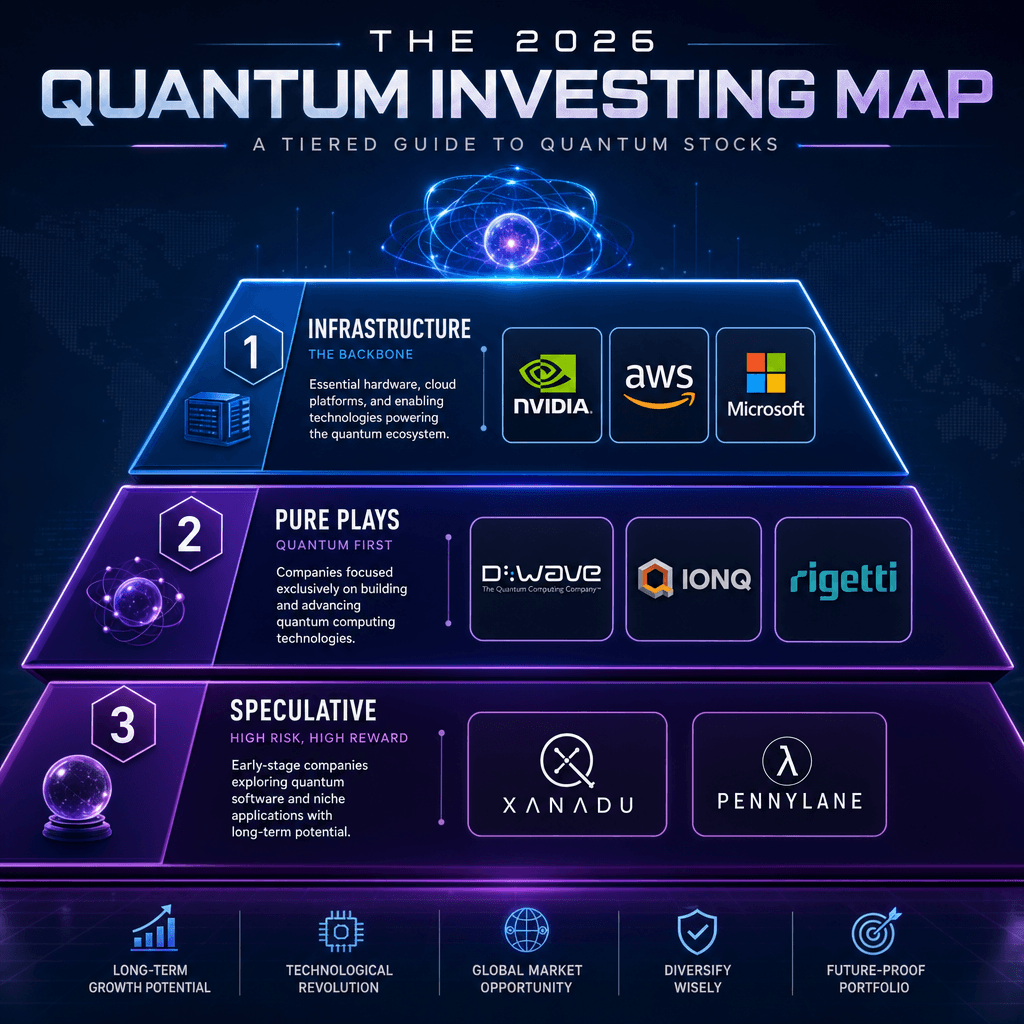
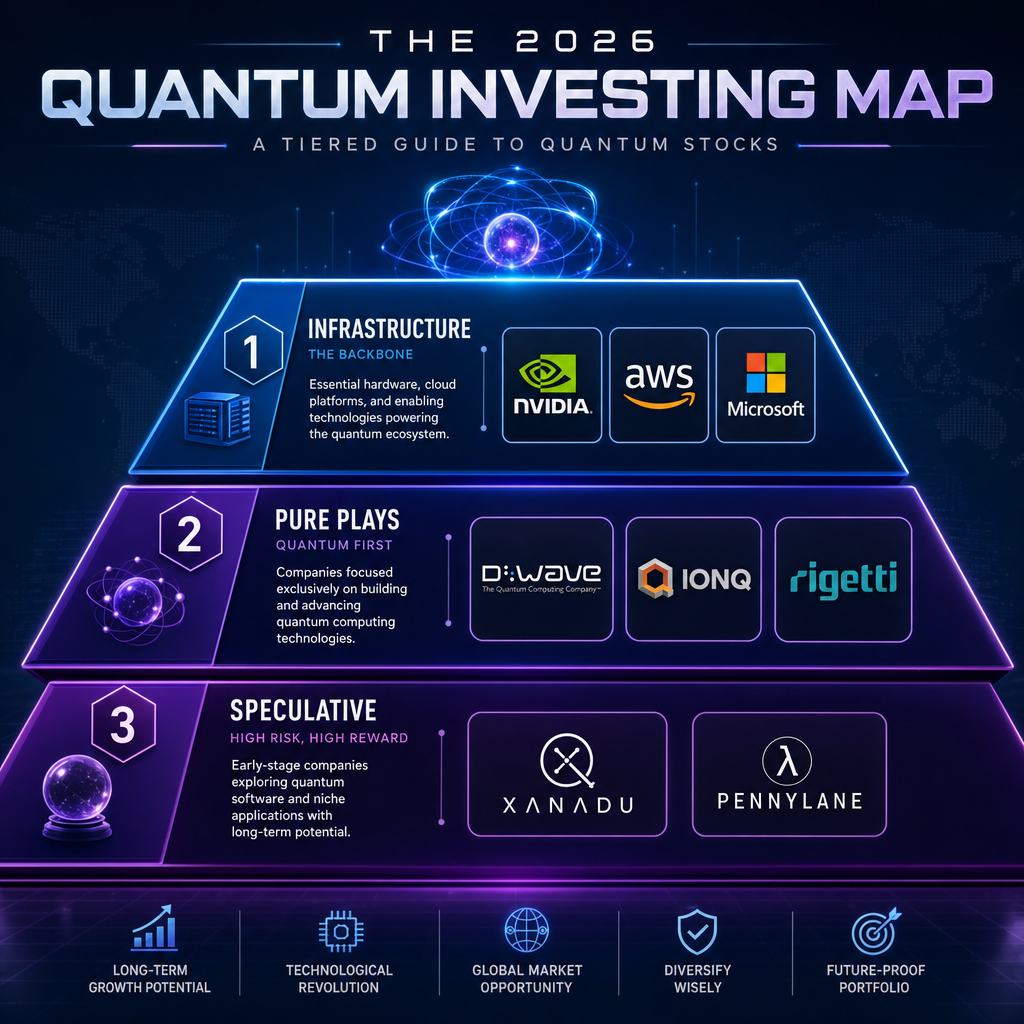
How to Allocate: The TraderCongress Three-Tier Framework
If I had $100 to allocate across quantum today, I'd break it into three tiers. And the allocation has shifted from six months ago—here's why.
Tier 1: Infrastructure Layer — $50 (The Anchor)
This is the foundation of the portfolio. Names like Amazon (AMZN), Microsoft (MSFT), and Nvidia (NVDA) generate real cash flow today while every quantum pure play burns through theirs.
They get the biggest slice because they win regardless of which quantum architecture succeeds. If quantum takes off, they collect tolls. If quantum stalls, their core businesses keep growing.
Six months ago, we'd have put $70 here. But the pure play universe has matured enough to justify shifting more capital toward direct quantum exposure.
Tier 2: Pure Play Builders — $35 (The Growth Engine)
This is where you bet on quantum commercialization directly: IonQ, D-Wave, Inflection, Horizon Quantum.
Yes, there's more risk here. But if the commercialization arc plays out over the next two to three years, this is where the outsized returns come from.
The reason we're willing to put more here than six months ago is straightforward. The market correction gave us better entry points across the board. And the pure play universe has doubled—meaning you can now diversify within this tier rather than concentrating on two or three names.
Tier 3: Penny Dreamers — $15 (The Speculative Edge)
Think Xanadu with its photonic hardware and PennyLane software platform. CLSQ in quantum security. Arqit in quantum encryption.
These are early-stage names where a single breakthrough could multiply your investment. Or where you could lose it all. Only put money here that you can afford to walk away from entirely.
Prefer a Basket? ETF Options
If picking individual names feels like too much, the Defiance Quantum ETF (QTUM) has been around the longest in this space. But there are now five other quantum-focused ETFs that didn't exist a year ago. Compare their holdings, fee structures, and strategy alignment before choosing one.
Putting It All Together
Quantum investing in 2026 isn't about finding a single winner. It's about understanding a sector that's expanding rapidly, recognizing the difference between real commercial traction and hype, and building a position that reflects your actual risk tolerance—not your FOMO.
The 37% rule exists for a reason. Watch first. Build your baseline. Then act when the evidence justifies it.
You've now got the baseline. You know the four architectures. You know the seven public pure plays and the three IPOs coming. You know which companies have revenue and which ones have lawsuits. You know the fear flip and the dilution risk.
The next time one of these names moves, you'll know whether it's noise or a signal.
That's the edge. Use it wisely.
For more deep-dive research, portfolio insights, and stock analysis, subscribe to the TraderCongress newsletter. We track the sectors that matter—before they make the headlines.
Disclaimer: This article is for educational and informational purposes only. It is not financial advice. Always do your own research and consult a qualified financial advisor before making investment decisions. The author may hold positions in some of the stocks mentioned.
FAQ
What are the best quantum stocks to buy in 2026?
The best quantum stocks depend on your risk tolerance. IonQ and D-Wave offer the strongest revenue growth among pure plays. Infrastructure names like Nvidia and Microsoft provide quantum exposure with less downside risk. Inflection stands out among new entrants with $32M in revenue and Nvidia backing. Always evaluate entry points against your personal risk framework.
How many publicly traded quantum pure plays exist today?
As of April 2026, there are seven publicly traded quantum pure plays, up from just four six months ago. Three additional companies—Quantinuum, IQM, and Pascal—are in the IPO pipeline and expected to go public by the end of 2026. That would bring the total to ten or more.
What are the four quantum computing architectures?
The four architectures are superconducting (used by D-Wave and Rigetti), trapped ion (used by IonQ and Quantinuum), neutral atom (used by Inflection and IQM), and photonic (used by Xanadu and Pascal). Each has distinct engineering trade-offs around precision, scalability, and cooling requirements. For the first time, all four are publicly investable.
Is QUBT (Quantum Computing Inc.) a good investment?
QUBT carries significant risk. 2025 revenue was only $682,000, the 10-K includes a going-concern warning, and the company faces securities fraud lawsuits alleging overstated NASA relationships. It's the highest-risk name among quantum pure plays. Investors should exercise extreme caution and only consider capital they can afford to lose entirely.