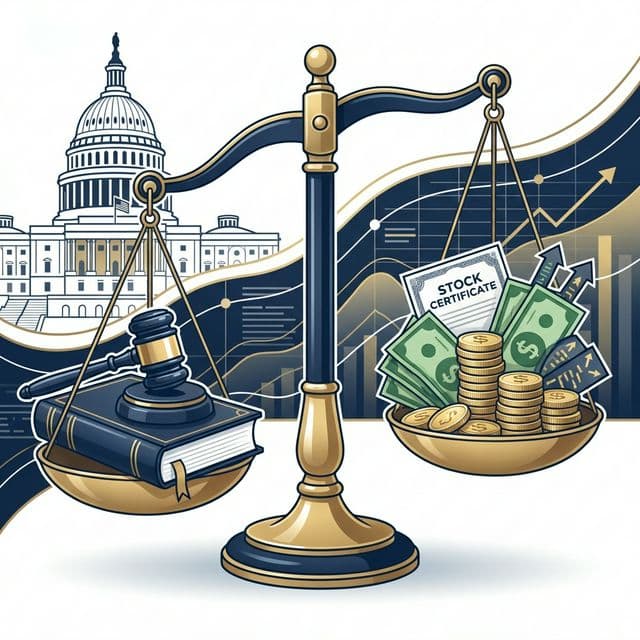
Can members of Congress legally trade stocks? What are the rules, restrictions, and penalties? A plain-English guide to the legality of political stock trading in 2026.
The Short Answer: Yes, With Restrictions
Members of the United States Congress can legally buy and sell individual stocks, bonds, options, and other financial securities. There is no blanket ban on congressional stock trading. However, they are subject to certain rules — primarily the STOCK Act of 2012 — that prohibit trading on material, non-public information and require disclosure of transactions. This article is part of our complete guide to congressional stock trading.
The legality of congressional stock trading is one of the most frequently asked questions in political finance. The answer is nuanced: the activity itself is legal, but the way many members appear to trade — with suspiciously well-timed transactions around committee hearings, classified briefings, and pending legislation — raises serious questions about whether existing laws are being violated without consequence.
What Is Legal
Under current federal law, members of Congress are permitted to engage in the following financial activities:
- Buying and selling individual stocks: Fully legal, as long as trades are disclosed within 45 days.
- Trading in the same industries they regulate: Legal. A member of the Senate Energy Committee can buy ExxonMobil stock. A member of the Armed Services Committee can buy Raytheon. There are no sector restrictions.
- Spouse and dependent trading: Legal. Spouses and dependent children can trade freely; the member must report these trades but can claim no involvement.
- Options and derivatives: Legal. Members can buy calls, puts, and other derivatives.
- Large transactions: Legal. There is no cap on the dollar amount of trades.
- Trading during market-moving legislative sessions: Legal. Members can trade while actively voting on bills that directly affect the companies in their portfolios.
What Is Illegal (In Theory)
The STOCK Act and existing securities law prohibit certain specific behaviors:
- Trading on material, non-public information (MNPI): If a member learns in a classified briefing that a specific company will lose a government contract, and then sells their shares before the public announcement, that is insider trading — and it is a federal crime under Section 10(b) of the Securities Exchange Act of 1934.
- Tipping: Sharing MNPI with family, friends, or associates who then trade on it is also illegal under the tippee liability doctrine established in Dirks v. SEC (1983).
- Failing to disclose: Not filing a Periodic Transaction Report (PTR) within 45 days is a violation — technically punishable by a $200 fine, and in extreme cases, criminal penalties up to $50,000 and a year in prison.
- Corruption and bribery: Trading stocks as a quid pro quo for legislative action violates federal bribery statutes (18 U.S.C. § 201), separate from the STOCK Act.
What Are the Penalties for Congressional Insider Trading?
The penalty structure for congressional stock trading violations operates on two tracks:
STOCK Act Penalties (Civil)
- Late filing fee: $200 per violation for failing to file a PTR within 45 days. This fee is routinely waived by the House and Senate Ethics Committees.
- Escalated penalty: In theory, repeated late filers can face penalties up to $50,000 per violation — but this has never been enforced.
- Criminal penalties: Knowing and willful violations can carry up to one year in prison and fines up to $50,000. No member has been charged under this provision.
Federal Securities Law Penalties (Criminal)
- SEC insider trading charges: Under the Securities Exchange Act, insider trading convictions carry penalties of up to 20 years in federal prison and fines up to $5 million for individuals.
- DOJ prosecution: The Department of Justice can bring criminal insider trading charges separate from the SEC's civil enforcement actions.
- Disgorgement: Courts can order the return of all profits gained or losses avoided through illegal trading.
The disparity is stark: corporate executives routinely face SEC enforcement actions and criminal prosecution for insider trading (the SEC brought 40+ insider trading cases in 2024 alone), while members of Congress face essentially no consequences for similar behavior. This double standard is at the heart of the public debate over congressional trading reform.
The Enforcement Problem
While the laws exist, enforcement against members of Congress is exceptionally rare. Consider these facts:
- Zero criminal convictions under the STOCK Act for insider trading since its passage in 2012.
- The $200 late-filing penalty is routinely waived by the House and Senate Ethics Committees.
- Investigating a sitting member of Congress for insider trading requires coordination between the DOJ, SEC, and Ethics Committees — an inherently political process.
- The burden of proof is high: prosecutors must demonstrate that a specific trade was motivated by specific non-public information, not by general market analysis or publicly available news.
Why Prosecution Is Rare
Several structural factors make congressional insider trading cases nearly impossible to prosecute:
- Speech or Debate Clause: Article I, Section 6 of the Constitution protects members from being questioned about their legislative activities. Prosecutors cannot subpoena records of committee discussions or floor conversations to prove MNPI access.
- Political calculus: The DOJ operates under the executive branch. Prosecuting sitting legislators from either party creates political complications that career prosecutors typically avoid.
- Self-policing: The House and Senate Ethics Committees investigate their own members. These committees are staffed by the colleagues of the very people they're supposed to oversee.
- Plausible deniability: Members can always claim their trades were based on publicly available information, personal financial planning, or the advice of a financial advisor — not on any non-public information.
In practice, this means members can trade with near-impunity. The spousal loophole and late filing strategies further reduce accountability.
Notable Cases and Investigations
While no member has been convicted under the STOCK Act, several high-profile cases have drawn public attention to the issue:
The COVID-19 Trading Scandal (2020)
In January 2020, members of the Senate Intelligence Committee received classified briefings on the emerging COVID-19 threat. In the weeks that followed, several senators sold significant stock holdings before the market crash in March 2020:
- Senator Richard Burr (R-NC): Sold up to $1.7 million in stocks on February 13, 2020, just weeks before the market crashed 34%. The DOJ opened an investigation, the FBI seized his phone, and he stepped down as Intelligence Committee chairman. The investigation was ultimately dropped in January 2021 without charges.
- Senator Kelly Loeffler (R-GA): Reported up to $3.1 million in stock sales following a January 24, 2020, Health Committee briefing. She denied any wrongdoing and attributed the trades to her financial advisors.
- Senator Dianne Feinstein (D-CA): Her husband sold $1.5–6 million in biotech stocks in late January 2020. Feinstein said she had no involvement in the trades.
The COVID-19 trading scandal was the most visible test of STOCK Act enforcement — and the result was zero prosecutions.
Representative Chris Collins (2018)
While not a STOCK Act case, Rep. Collins (R-NY) was convicted of securities fraud in 2019 for tipping his son about the failure of a clinical drug trial at Innate Immunotherapeutics, a company on whose board Collins sat. He was sentenced to 26 months in federal prison. This remains the only insider trading conviction of a sitting member of Congress in modern history — and it was prosecuted under general securities law, not the STOCK Act.
Congressional Trading vs. Corporate Insider Trading
There is a striking difference in how insider trading is treated depending on who does it. For a deeper analysis, see our full article: Congressional vs. Corporate Insider Trading.
| Dimension | Corporate Insiders | Members of Congress |
|---|---|---|
| Disclosure window | 2 business days (SEC Form 4) | 45 calendar days (STOCK Act PTR) |
| Enforcement body | SEC + DOJ (independent) | Ethics Committee (self-policing) + DOJ |
| Annual enforcement actions | 40+ per year | Zero since 2012 |
| Late filing penalty | SEC can bar from serving as officer/director | $200 (routinely waived) |
| Maximum criminal penalty | 20 years + $5M fine | Same in theory, never applied |
| Pre-clearance required | Yes (at most public companies) | No |
| Blackout periods | Yes (around earnings) | No |
The Blind Trust Option
Members can voluntarily place their assets in a qualified blind trust, managed by an independent trustee. In a true blind trust, the member has no knowledge of or control over the specific investments. However:
- Blind trusts are not mandatory — they are entirely voluntary.
- Only a small minority of members use them. As of 2025, fewer than 30 of 535 members had active blind trusts.
- The initial assets placed in the trust are known to the member, making the trust only "blind" to subsequent changes.
- Members must apply to and receive approval from the Ethics Committee to establish a qualified blind trust, and the process can take months.
Proposed Bans and Reform
Several bills to ban congressional stock trading have been introduced, with bipartisan support:
- The End Congressional Stock Trading Act (H.R. 1908, 2025): Would ban members and their spouses from trading individual stocks. Introduced by Rep. Abigail Spanberger and Sen. Josh Hawley.
- The ETHICS Act: Would require mandatory blind trusts for all members with financial assets above a threshold.
- The TRUST in Congress Act: Would ban individual stock trading entirely and require divestiture into diversified funds or Treasury securities.
- The Ban Congressional Stock Trading Act (2023): Introduced by Sen. Jeff Merkley and Sen. Josh Hawley with 20+ co-sponsors. Passed out of committee but never received a floor vote.
Despite 86% public support for a ban (per a 2023 Nielsen survey), no ban has passed. Leadership in both chambers has repeatedly declined to bring trading ban legislation to a vote. For analysis on the political dynamics, read: The Battle to Ban Congressional Stock Trading.
What This Means for You
Congressional stock trading is legal, lightly regulated, and poorly enforced. This reality is unlikely to change in the near term. For investors, this creates an opportunity: since members are required to disclose their trades (even if belatedly), you can monitor, analyze, and act on this data.
The most effective approach is to focus on high-conviction signals: large purchases ($50K+), bipartisan clustering (multiple members buying the same stock), committee-relevant trades (a member of the Armed Services Committee buying a defense contractor), and cross-referencing congressional trades with other data sources like government contract awards and lobbying activity.
TraderCongress aggregates these disclosures — along with SEC insider filings, government contracts, lobbying data, dark pool activity, and federal spending — into a single, real-time dashboard. The law may not stop political trading, but it does ensure you can see it. Use that visibility to your advantage. See our comparison of the best tools for tracking congressional trades.